Showing posts with label Graphixia. Show all posts

Tuesday, April 15, 2014

JACK KIRBY, WRITER

I've written an article on Jack Kirby's contribution to comics as a writer.
It's been published over at Graphixia.
Please go here to have a look.

"Jack Kirby’s writing came in for a lot of criticism in the 1970s after he made the break from Marvel Comics to DC Comics. And as time has gone on, Kirby’s dialogue can increasingly be read as stilted, in an age where “believable” or failing that, witty interchange between characters is much prized. He is out of step with how culture has gone because he is so earnest in his writing.
Due to their great success in the 1960s at Marvel Comics, which were credited to Stan Lee as writer and Kirby as artist, it is tempting to look at those comics,  compare them to Kirby’s later work and subtract the difference as being Lee’s contribution. There is much debate about who exactly was responsible for what though, as Gerard Jones states:
“Stan turned to Jack Kirby and through a process now eternally obscured by competing stories – both men claimed to have had all the basic ideas first – introduced Fantastic Four” (a)
Traditional notions of what a writer and an illustrator do Kirby are surely too simplistic when applied to comics, as recounted by Ronin Ro:
“When Stan saw the Surfer in his pages, he asked “Who the hell’s this?” “ I figured anybody as powerful as Galactus ought to have a herald who would go ahead of him and find planets,” Jack replied. “That’s a great idea!” (b)
Leaving aside the thorny issue of what exactly is meant by writer in these credits, amongst what one might assume to be the Lee contribution is snappy banter between characters, witty and self-knowing asides and a more general showman/ringmaster persona that he brought to the editorial side of his work.
This leaves Kirby with imaginative design in characters and environments, dramatic pacing, and a smaller or greater element of the plot depending on how detailed initial instruction from Lee was.
By the time Kirby is doing the writing and drawing at DC, the imaginative characters, locations and plots are intact (arguably even more so), and the action and story progression is still very dynamic. What has been lost is a street level, smart-talking point of entry. Lee’s writing was done in reaction to Kirby’s artwork. In a sense he was commenting on what Kirby had created in the artwork.
Kirby was always interested in creating new characters, situations and environments. In the late 60s, he proposed his New Gods ideas to Marvel, who didn’t want to use them. He took them to rivals DC instead.
Kirby often used Gods, or variations on powerful celestial beings, in his stories. His contention that he, and not Lee, came up with the idea to do comics based on Norse mythology gains credence from the fact that Kirby had already done a version of Thor at DC in 1957 before doing it for Marvel in 1962.

Kirby ThorKirby, Thor, DC Comics, 1957
Kirby was interested in technology, machinery, and philosophy. But anyone who thinks Kirby could not deliver on an emotional level would be mistaken. Just look at this one panel from Mister Miracle …
Kirby Mister Miracle
 Kirby, Mister Miracle, DC Comics, 1974
It’s melodramatic, but even without any context, you have the sense of what Oberon (on the left) is feeling in this picture.
When Kirby returned to Marvel in the mid 70s, his contract afforded him the opportunity to officially write, draw and edit his own books, a condition that Lee was willing to capitulate to in order to get Kirby back. He set to work on Eternals…
Kirby Eternals
Kirby, Eternals, Marvel Comics, 1976
Kirby was keen to create more new stories, characters and situations, in opposition to what had become the Marvel norm, whereby all the comics fed into each other to varying extents (all characters in Marvel Comics  had to meet Spider-Man at some point, be they Howard the Duck, Transformers or the Frankenstein monster).  Kirby did not want to create stories which had to negotiate through the convoluted continuity of twenty or so years of previously published comics. As Sean Howe writes, 
“In Captain America, assistant editor Roger Stern had to rewrite a Kirby reference to a flying saucer being “the first alien space craft ever to visit the Earth, “ a description that would discount scores of Marvel adventures and not a few of the characters.” (c)
I only later read any of the background on Kirby’s self-penned comics. Summing up the industry view of him at this point, Mark Evanier writes:
“Just then, he’d stopped beoing Jack Kirby, the guy who created, or co-created, so many successful new comics. With the end of his contract in sight, he was Jack Kirby, the guy who did those wonky, unreadable books that didn’t sell so great.”(d)
Evanier also writes:
“Years after, his seventies work would be regarded more favourably, and even reprinted, right along with everything else he did, time and again. Some would even say the sales figures weren’t as dour as the rumours of the times insisted”. (d)
Anecdotally, I bought and read them. Perhaps there is a generational element to one’s appreciation of Kirby’s writing. The late 1970s Captain America were actually the first comics I read by Kirby, and I thought they were terrific as a kid. Instead of the wry, slightly arch dialogue of Lee though, in Kirby’s self-scripted comics we instead have an earnest, almost poetic series of statements. These are sentences that no-one has ever said or ever will say. They are not capturing a realistic conversational tone, they are lines which aspire to be about the magical, the fantastic, the wonderful. In this respect they are more in tune with the artwork. The totality of the comic is now Jack Kirby.
Kirby Silver Star
Kirby, Silver Star, Pacific Comics, 1983
Postscript
Incidentally, although Kirby’s dialogue and writing is unique, another writer whose work reminds me of him is Ann Nocenti. In Longshot she is also operating in a similarly fantastical environment filled with outlandish characters. See this following discourse…
Nocenti Adams Longshot
Nocenti, Adams, Longshot, Marvel Comics, 1986
Jones, G. (2005) Men of tomorrow: geeks, gangsters and the birth of the comic book, London: Wiliam Heinemann, p.295
Ro, R. (2004) Tales to astonish: Jack Kirby, Stan Lee, and the American comic book revolution, New York: Bloomsbury, p.99
Howe, S. (2012) Marvel comics: the untold story, New York: Harper, pp.194-195
Evanier, M. (2008) Kirby: king of comics, Abrams, New York, p.187"

Tuesday, January 28, 2014

A COLLABORATIVE DUMP at GRAPHIXIA

http://www.graphixia.cssgn.org/2014/01/28/152-a-collaborative-dump/
Damon Herd, who drew the story "Why I Vote" in Dump #2, has written on our collaboration over at Graphixia.

Have a read here.

"For this week’s post I’d like to give a little insight into a collaboration process that I have gone through recently. My first comics collaboration happened when I was about 8 years old. A pal and I created a strip that was a rip-off of Danger Mouse. We didn’t do anything with it, I don’t think we even finished it. It was just a way to pass some time doing something we both enjoyed.

It was 30 years before I collaborated on another comic, while I was studying for my MA illustration. One of the projects involved teaming up with a writer from Edinburgh University’s creative writing MA. We were paired at random but ‘my’ writer, Chris Lindores, was also into comics. We decided that I would illustrate an existing poem of Chris’s and we met a few times to discuss the adaptation. Although the poem was based on real events – my love of autobiographical comics showing through! – there was a shared liking for Batman so that somehow crept in. Looking back the strip is OK, if a little literal, too much show AND tell going on.
Words by Chris Lindores, art by Damon Herd

At the end of last year another opportunity for collaboration came up when my friend, the cartoonist David Robertson, asked me if I would like to contribute a one page strip to the next issue of his comic Dump. Much like myself, David is quite content to be producing his own comics purely for the sake of making comics. This isn’t a get rich quick scheme or the first step in a career in the movies, this is making comics for the love of comics. With a day job and family to occupy most of his time David manages to produce strips whenever he gets a spare moment, and gradually the stories build up until he has enough material to publish a book. His comics are refreshingly uncynical and have a wry sense of humour. Whenever I host a DeeCAP comics performance event in Dundee I always ask David to contribute, as this humour comes through in his deadpan delivery, and he knows how to work an audience.

Cover of Dump issue 2 by David Robertson

Dump serialises David’s ongoing strip Dump, which details the adventures of Bert, the main character from David’s webcomic, Berserkotron, who now works at the local rubbish tip. The book also acts as a repository (or dump) for David’s other strips, including One Day at Space Wizard Central (a highlight at a previous DeeCAP) and History of E-mail and the Internet. For the latest issue he decided to collaborate with artists Neil Paterson, Keara Stewart, Donna Law, and Stephen Boyd, as well as myself, on five one page strips. David wrote the scripts and we produced the art, apart from Stephen’s strip, where David wrote the story to fit existing artwork.

David actually gave the artists a choice on whether they wanted to write and draw their own strips but everyone decided to illustrate David’s scripts. Typical of us lazy artists! But we should be careful what we wish for. When the script arrived it wasn’t what I was expecting. I thought it would be all text, dialogue with descriptions of the scenes, but what turned up was a fully sketched out page with thumbnailed panel layouts and dialogue. I joked that David was ‘no Stan Lee’ because he had supplied such detailed scripts, no Marvel method here! At first I didn’t think this left much room for collaboration, David had asserted what Scott called his ‘textual authority’ but as I read through the script I realised that there were certain things I could bring to the page.

David’s script was set out on a strict 12-panel grid and I felt that the flow of the page could be improved slightly. I wanted to contain on one row the sequence of three panels that occurs in one character’s head. This meant rejigging the other panels on the page, I had to expand the previous two panels to fill a row and lose a panel on the final tier. This seemed to work as I could still put all the remaining dialogue in the final three panels, or so I thought (more on that in a moment). So, while the underlying grid was still 12 panels, I had managed to tell the same story in 11 panels. As the scene was basically two people talking in an office I used Wally Wood’s 22 Panels That Always Work, to help with a few panels (you might notice the ones I swiped).

David’s original thumbnails (L) & Damon’s (R)

I sent David a rough sketch of my layout and he remarked that he liked the two panel ‘Smith and Jones’ row but was worried that I wasn’t using all the dialogue. I assured him that I would but had only scribbled a few lines on the layout sketch for speed. Turns out he was right to worry. I sent him the finished scan just before Christmas (I think he was tapping his feet waiting on me so he could send the finished book to the printers). A copy of the freshly printed comic dropped through my letterbox soon after the New Year and I was very pleased to see how it turned out.

I met up with David last week and we discussed how the process had gone. He had been really pleased with how each cartoonist had approached his scripts, a couple of us had moved a few panels around but the strips still presented David’s stories. Then he pointed out something missing from my finished strip – half the dialogue in the final three panels! Apparently the scan he sent me was incomplete so I never received the text, however the strip still made sense so I never noticed. David had wondered if he should ask me to redo the strip, but agreed that it still made sense even if it wasn’t exactly what he had intended. Also, the repositioning that I did to his panels would not have worked as well if I had tried to squeeze in the missing dialogue.
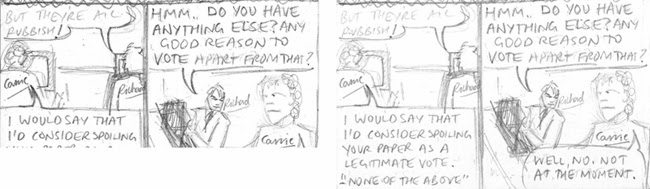
Penultimate two panels as supplied (L) & as drawn (R)

I think that is the joy of a collaboration, things don’t quite turn out the way you planned them. Another person’s interpretation of the same problem will likely generate different results from your own, and hopefully the input from two people creates something that neither of you would have produced on your own. It is like the ‘mathematics’ of comics, words + images = something much more than just a simple combination of the two."