Sunday, February 09, 2014

Saturday, February 08, 2014

DUMP #2 GUEST ARTIST INTERVIEW: STEPHEN BOYD


Beginning today is a series of mini-interviews with the guest  artists who are featured in Dump #2. First up is Stephen Boyd…

DR: Have you always been interested in comics?
SB: Yes.....and no. I grew up with Oor Wullie, The Broons (in Scotland it's kind of mandatory to read these as a kid and it's ok not to grow out of them), The Beano all those DC Thomson staples. Then I discovered Starblazer comics and would pick them up if the cover grabbed me, which was often because I love sci-fi.


I used to occasionally pick up The Eagle and I bought 2000AD religiously. In my teens I really enjoyed stuff like Crisis, Strip and Toxic (while they lasted). I read The Sandman, Alan Moore and Akira as a student and then I got bored of comics. I'd look at what was made available to me in deepest darkest Dundee, but it all seemed a bit silly. Except for Maus, which blew me away, but as far as I was aware that was a one of a kind blip, so my interest in comics dried up for a few years. And then someone introduced me to Jaques Tardi's 'It was the war of the trenches' when it was released by Fantagraphics and that opened up a whole new world of comics that I'd been missing for all these years. I’ve been pretty much catching up since.
DR: You’re welcome. What had been your experience in making comics yourself before your contribution to Dump?


SB: It's actually been quite limited. I drew comics when I was a kid, silly little stick figures acting out jokes, but what 6-10 year old didn't? This carried on into my teens, mostly Viz knock offs and 2000AD inspired nonsense. I'd always liked drawing and did art at higher level but found the teachers at my school downright unhelpful, particularly if you wanted to follow a more graphic or comic bookish path. I left school with 2 highers, English and Art and always said I was only ever qualified to write and draw my own comics yet never got round to doing it. I still kept a hand in at the drawing, just as a hobby, while I pursued other interests, but the nearest I got to anything comics related was trying to learn to draw in the manga style. And that was it till my mid 30s. The relationship I was in at the time broke up and I found myself with a lot of spare time on my hands so I drew to stop my brain thinking. That drawing became the beginnings of a few comics that I never got round to finishing but had potential if I possessed anything amounting to an attention span. Of course, you and I worked together in the real world at this point and you saw much of the work I was doing, and did best at encouraging me to continue working on it. I intend to finish them off someday in the future or maybe start something else but I'm so busy just now with my nurse training. I still draw and my style has taken on a quicker, more sketch like immediacy, partly because I need to work in a hurry because life's so damned busy, partly so I can finish a piece before my attention span drifts off again and partly because I'm unashamedly trying to draw like Eddie Campbell.
DR: How’s the music going?
SB: Slowly, but well. I'm slowly putting another EP together but who knows when it'll be ready. Again its finding the time to record at the moment. I get a lot of false starts the way I make music. I write as I record so I never have that much of a notion of a finished piece at the beginning. I prefer it that way, much more exciting and organic. I like the chance to experiment while creating and it's hard to do that with too many pre-conceived ideas before starting. The more you prepare beforehand the less honest it gets I feel. You might have found that with your story 'Everything' I'm guessing. 


Anyhoo, I'm a big fan of the ethos of Sister Corita Kent, a nun who taught art and made posters in LA during the 1940s and all the way through to the 60s. She wrote these 10 rules for her schools art department to promote creativity  and includes gems such as 'Rule 4 - Consider everything as an experiment' and 'Rule 6 - Nothing is a mistake. There's no win and no fail. There's only make'. I like that idea. Sure it may result in creating something self-indulgent, but to a degree the very act of creating and putting it out there for others to see or hear is self-indulgent and I have no problem with that. My only problem just now is not following Rule 7 enough ‘The only rule is work. If you work it will lead to something. It’s the people who do all of the work all of the time who eventually catch on to things’.
DR: I suggest your next recording session should be done live with a bass player and drummer.
SB: I’m game for that. It’s one of the things you miss not being in an actual ‘band’, that spontaneity of jamming, the one time, never to be repeated performance. I listen to a band like Godspeed You! Black Emperor and think one person couldn’t possibly create that, music like that can only be made by a collective of musicians with a long enough runway but then you hear Mike Oldfield’s Tubular Bells knowing that it’s all the work of one bloke with a lot of time and dedication spent on his craft. There’s more than one way to do these things and I’d like to try them all out and see the end product of each of the different processes, for better or worse. As the good sister said, ‘Nothing is a mistake’.
DR: OK, let’s record our next jam then.
Unlike the other stories in Dump where I gave the artists a script, kind of, more exactly a page layout with dialogue, doodles and stage directions, I wrote Dream of Being You on top of your existing page of art. How was it seeing the finished page? Imagine I’m not me and answer truthfully.
SB: It would be an understatement to say that I was really pleased with it. It was the first time I'd ever seen anything of mine in print and I showed it to everyone I knew saying how I was technically a published comic book artist. Process wise, it was an odd way of doing the strip but I'd definitely do it again. I remember getting the e-mail to draw a page and thinking I'd love to but I just don't have the time. I had a collection of single page efforts and offered you your pick of those. Originally it was going to go in unchanged but then you asked if you could rewrite over it Marvel style (which I reckon you had planned to do all along) which I had no problem with. My story was OK but nothing special and certainly not something I was emotionally invested in. I much prefer what you did with it.


DR: I guess I have to answer your gentle accusation. When I took your page I was originally going to run it as it was. As I got closer to publication though, it did start to niggle at me that I had written everything in the comic except your page. It felt like your story was an oddity in there. It occurred to me that I could write on it, if you were OK with it. So no, I hadn’t planned it all along. 
Anyway, just to confirm: Can we expect to see more comics from you in the future?
SB: Sorry about the cheeky wee quip, I have absolutely no doubt in your intentions and to be fair I would have felt the same niggle for exactly the same reasons. I get very like that with music hence my short lifespan in most of the bands I've been a part of. And as I said, your story was far better.
Now, to answer your question. I'd like to think there would be more comics out there with my grubby paw prints on them in some way in the future but who knows. I did consider starting a blog that was just single strips or instalments of stories, like you did with Berserkotron, and perhaps that will still come to something, perhaps not. What I can say is that there will definitely be another E.P. release by The quietest page before any future comics related work.

You can have a listen to Stephen’s music at http://thequietestpage.bandcamp.com/ and https://soundcloud.com/itsred

Thursday, January 30, 2014

DUMP #2 at OPTICAL SLOTH


Kevin Bramer has written on Dump #2 over at Optical Sloth.

Have a look here.

"Does this actually not say “#2″ on the cover? No, I guess not. I had a few questions about various things in this one before I started (that cover, the abrupt ending of the Dump story) but David covered all that in his afterward, so never mind. This one starts with the second part (of three) of the “Dump” story, this time focusing on our hero as he gets more and more miserable at work, but he does finally meet somebody he can talk to and commiserate with. I love the little touch of the Garvo-Munchers, little horror shows of eyeballs and tentacles, amidst the generally mundane tone of the rest of the story. I’m looking forward to the finale of this one in the next issue, although he might want to put the whole story in one comic when it’s finished, considering the average attention span in this day and age (myself sadly included in that). The short pieces in here dealt with trying to remember the name of that one actor guy, a bicycle ride with a nice ending, overthinking things at a party, trying to come up with a good argument in favor of voting, coleslaw, appreciating what you have and an informal history of e-mail and the internet. Read that last part and feel old! Or bitter at the youngsters because they’ve always had the answer to every question in the world at their fingertips. The other big story in this one (it’s a pretty hefty comic) is David’s 24 hour comic. He starts with a brief history of the 24 hour comics, mentions how one of the rules is to go into such things without a plan, and ends up with a pretty damned compelling comic. He goes into detail about his own history, how he always wanted to do comics but ended up trying a bunch of different things because he couldn’t see a way for comics to be taken seriously. This is where the internet comes in, as the message board for The Comic’s Journal helped all kinds of people from all over the world (David is in Scotland) come together. 24 hour comics can be a bit of a mess, so it’s always nice to see one put together as well as this, especially considering the conditions involved in making such a thing. Read it and enjoy, as there’s plenty to like in here. Don’t let that innocuous cover scare you off!"

Does this actually not say “#2″ on the cover? No, I guess not. I had a few questions about various things in this one before I started (that cover, the abrupt ending of the Dump story) but David covered all that in his afterward, so never mind. This one starts with the second part (of three) of the “Dump” story, this time focusing on our hero as he gets more and more miserable at work, but he does finally meet somebody he can talk to and commiserate with. I love the little touch of the Garvo-Munchers, little horror shows of eyeballs and tentacles, amidst the generally mundane tone of the rest of the story. I’m looking forward to the finale of this one in the next issue, although he might want to put the whole story in one comic when it’s finished, considering the average attention span in this day and age (myself sadly included in that). The short pieces in here dealt with trying to remember the name of that one actor guy, a bicycle ride with a nice ending, overthinking things at a party, trying to come up with a good argument in favor of voting, coleslaw, appreciating what you have and an informal history of e-mail and the internet. Read that last part and feel old! Or bitter at the youngsters because they’ve always had the answer to every question in the world at their fingertips. The other big story in this one (it’s a pretty hefty comic) is David’s 24 hour comic. He starts with a brief history of the 24 hour comics, mentions how one of the rules is to go into such things without a plan, and ends up with a pretty damned compelling comic. He goes into detail about his own history, how he always wanted to do comics but ended up trying a bunch of different things because he couldn’t see a way for comics to be taken seriously. This is where the internet comes in, as the message board for The Comic’s Journal helped all kinds of people from all over the world (David is in Scotland) come together. 24 hour comics can be a bit of a mess, so it’s always nice to see one put together as well as this, especially considering the conditions involved in making such a thing. Read it and enjoy, as there’s plenty to like in here. Don’t let that innocuous cover scare you off! - See more at: http://www.opticalsloth.com/?p=22649#sthash.K5sGCj3d.dpuf

Tuesday, January 28, 2014

A COLLABORATIVE DUMP at GRAPHIXIA

http://www.graphixia.cssgn.org/2014/01/28/152-a-collaborative-dump/
Damon Herd, who drew the story "Why I Vote" in Dump #2, has written on our collaboration over at Graphixia.

Have a read here.

"For this week’s post I’d like to give a little insight into a collaboration process that I have gone through recently. My first comics collaboration happened when I was about 8 years old. A pal and I created a strip that was a rip-off of Danger Mouse. We didn’t do anything with it, I don’t think we even finished it. It was just a way to pass some time doing something we both enjoyed.

It was 30 years before I collaborated on another comic, while I was studying for my MA illustration. One of the projects involved teaming up with a writer from Edinburgh University’s creative writing MA. We were paired at random but ‘my’ writer, Chris Lindores, was also into comics. We decided that I would illustrate an existing poem of Chris’s and we met a few times to discuss the adaptation. Although the poem was based on real events – my love of autobiographical comics showing through! – there was a shared liking for Batman so that somehow crept in. Looking back the strip is OK, if a little literal, too much show AND tell going on.
Words by Chris Lindores, art by Damon Herd

At the end of last year another opportunity for collaboration came up when my friend, the cartoonist David Robertson, asked me if I would like to contribute a one page strip to the next issue of his comic Dump. Much like myself, David is quite content to be producing his own comics purely for the sake of making comics. This isn’t a get rich quick scheme or the first step in a career in the movies, this is making comics for the love of comics. With a day job and family to occupy most of his time David manages to produce strips whenever he gets a spare moment, and gradually the stories build up until he has enough material to publish a book. His comics are refreshingly uncynical and have a wry sense of humour. Whenever I host a DeeCAP comics performance event in Dundee I always ask David to contribute, as this humour comes through in his deadpan delivery, and he knows how to work an audience.

Cover of Dump issue 2 by David Robertson

Dump serialises David’s ongoing strip Dump, which details the adventures of Bert, the main character from David’s webcomic, Berserkotron, who now works at the local rubbish tip. The book also acts as a repository (or dump) for David’s other strips, including One Day at Space Wizard Central (a highlight at a previous DeeCAP) and History of E-mail and the Internet. For the latest issue he decided to collaborate with artists Neil Paterson, Keara Stewart, Donna Law, and Stephen Boyd, as well as myself, on five one page strips. David wrote the scripts and we produced the art, apart from Stephen’s strip, where David wrote the story to fit existing artwork.

David actually gave the artists a choice on whether they wanted to write and draw their own strips but everyone decided to illustrate David’s scripts. Typical of us lazy artists! But we should be careful what we wish for. When the script arrived it wasn’t what I was expecting. I thought it would be all text, dialogue with descriptions of the scenes, but what turned up was a fully sketched out page with thumbnailed panel layouts and dialogue. I joked that David was ‘no Stan Lee’ because he had supplied such detailed scripts, no Marvel method here! At first I didn’t think this left much room for collaboration, David had asserted what Scott called his ‘textual authority’ but as I read through the script I realised that there were certain things I could bring to the page.

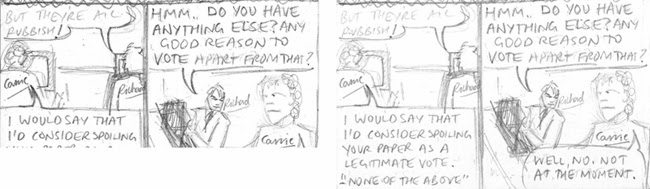
David’s script was set out on a strict 12-panel grid and I felt that the flow of the page could be improved slightly. I wanted to contain on one row the sequence of three panels that occurs in one character’s head. This meant rejigging the other panels on the page, I had to expand the previous two panels to fill a row and lose a panel on the final tier. This seemed to work as I could still put all the remaining dialogue in the final three panels, or so I thought (more on that in a moment). So, while the underlying grid was still 12 panels, I had managed to tell the same story in 11 panels. As the scene was basically two people talking in an office I used Wally Wood’s 22 Panels That Always Work, to help with a few panels (you might notice the ones I swiped).

David’s original thumbnails (L) & Damon’s (R)

I sent David a rough sketch of my layout and he remarked that he liked the two panel ‘Smith and Jones’ row but was worried that I wasn’t using all the dialogue. I assured him that I would but had only scribbled a few lines on the layout sketch for speed. Turns out he was right to worry. I sent him the finished scan just before Christmas (I think he was tapping his feet waiting on me so he could send the finished book to the printers). A copy of the freshly printed comic dropped through my letterbox soon after the New Year and I was very pleased to see how it turned out.

I met up with David last week and we discussed how the process had gone. He had been really pleased with how each cartoonist had approached his scripts, a couple of us had moved a few panels around but the strips still presented David’s stories. Then he pointed out something missing from my finished strip – half the dialogue in the final three panels! Apparently the scan he sent me was incomplete so I never received the text, however the strip still made sense so I never noticed. David had wondered if he should ask me to redo the strip, but agreed that it still made sense even if it wasn’t exactly what he had intended. Also, the repositioning that I did to his panels would not have worked as well if I had tried to squeeze in the missing dialogue.
Penultimate two panels as supplied (L) & as drawn (R)

I think that is the joy of a collaboration, things don’t quite turn out the way you planned them. Another person’s interpretation of the same problem will likely generate different results from your own, and hopefully the input from two people creates something that neither of you would have produced on your own. It is like the ‘mathematics’ of comics, words + images = something much more than just a simple combination of the two."

Monday, January 27, 2014

DUMP #2 at THE BIG GLASGOW COMIC PAGE

Gary Smith has written on Dump #2 over at The Big Glasgow Comic Page.
If you're on Facebook, please follow the link over to their page. If you're not, here's the text...

Issue 2 of 'Dump' is the latest publication from the Tayside based comics creator, David Robertson. The comic contains a variety of strips, ranging from one-page works produced with artistic collaborators to longer, more autobiographical works that are both written and drawn by Robertson.

The first story, Dump, nicely illustrates one of Robertson's key strengths: the juxtaposition between the often mundane nature of daily life and the absurdities that can be found within. This theme is continued in six one page strips, exploring such everyday scenarios as why people vote, social anxiety, and celebrity name association. The commonplace nature of many of the events depicted allow the reader to easily identify with the scenarios, with Robertson marrying this with a sly wit and a unique way of interpreting these familiar situations.

As enjoyable as these pieces are, for me the real success of the publication lies in the two stories that make up its second half. Autobiographical in nature, a 4 page story details Robertson's interpretation of the development of e-mail and the Internet, and how this has been reflected in his own life. A fascinating piece, it does a good job of highlighting not only the pace of change, but also how outlandish certain innovations seem in isolation and upon first introduction. Encompassing everything from Geocities to Twitter, Robertson also highlights his comic knowledge by providing a sly nod to technology from the Lee/Kirby run of the Incredible Hulk.

The final strip, 'Everything', is a treat. Produced from scratch as part of a 24-hour Comics Day event, this details Robertson's journey thus far, exploring the career, personal and social factors that have shaped his life to date. I am always fascinated by insights into the creative process and following Robertson's journey from youthful comic mash-ups to adult self publication is an engaging read. Robertson's art is not flashy but is simple and effective, a good fit for the everyday situations depicted in his work.

The format and production values of the title merit special mention. Modelled on the Penguin Classics template, the cover is instantly eye catching, while the reproduction inside is crisp and clear. The volume concludes with a short text piece from Robertson that gives an insight into the background for each story, as well as raising the tantalising prospect of a third issue of 'Dump' to be released in the future.

I must admit that I don't dip into the small press scene very often, but reading this work has reminded me of the quality that can be found out there and this is definitely an area that I'll look to explore further in the future. More information about David Robertson's work can be found at the following location:
Blog - http://fredeggcomics.blogspot.co.uk/
Website - http://fredeggcomics.piczo.com/

Saturday, January 18, 2014

Thursday, January 16, 2014

DUMP - THE FINAL PREVIEWS

Here are your last couple of previews from Dump 2. Click for larger versions.

Hey, Joe..?

History of E-Mail and the Internet.

I hope you've enjoyed the comics I've posted this week. If you have, and fancy buying a copy, please visit the Fred Egg Comics shop on the right.


Wednesday, January 15, 2014

DUMP GUEST ARTISTS

Dump no.2 features five stories written by myself and drawn by the following talented artists:
"Dream of Being You" by Stephen Boyd.

"Why I Vote" by Damon Herd.    


"Coleslaw" by Donna Law.

"Cycling Through Freedom" by Neil Paterson.

"Yay! Party" by Keara Stewart.

 And there is also the following:
Author portrait by Tanitoc.


Thanks very much to everyone who contributed. Great work, all!

To buy a copy of Dump #2, please go to the Fred Egg Comics shop on the right.

Tuesday, January 14, 2014

DUMP EVERYTHING

Here's another preview of my new comic Dump No.2. These are the first four pages of "Everything". Click images for larger view.


As mentioned in the story itself, this was done for 24 Hour Comics Day. A great, if exhausting experience.
If you'd like a copy of Dump No.2, please go to the Fred Egg Comics Shop on the right. Thanks to everyone who's bought one already.

Monday, January 13, 2014

DUMP #2 at COMIC BITS ONLINE


Terry Hooper-Scharf has written on Dump #2 over at Comic Bits Online.
Have a look here 

"This is actually a nice little package and £1 for 60 pages???? That is crazy, but that's just me.  The quality of printing is great and, hmm, why is that cover design so familiar?

Now, this was an enjoyable and fun read and although I cannot say any artist in particular leapt out of the page at me this was a true Small Press publication.  Saying it is Small Press is NOT insulting the creators involved -in the UK the Small Press is, after all, the grass roots comics industry.

And for £1.00 -how can you complain?  "Dump" reminded me somewhat of a strip you might find back in the 1980s in something like Knock Yaself Out Comix and "Hey, Joe?" was interesting. If asked, yes, I'd recommend this and it might inspire others to have a go at self publishing.

All together a great little book."