Saturday, September 27, 2014

COMICS STAMPEDE 8: COSEY

This one from Switzerland speaks for itself. Really nice composition by Bernard Cosendai AKA Cosey:


There is more information on the artist over at the excellent Lambiek site.

Tuesday, September 23, 2014

ADAM WARLOCK SKETCH by JIM STARLIN

Here's a sketch of Adam Warlock by Jim Starlin drawn at an event I wrote about previously.

Starlin was charming and I was very pleased to get this sketch from a childhood favourite.

Thursday, September 11, 2014

MARVEL MONEY

I joined a Facebook group called "Marvel UK Comics" today. I'm already in one called "Make Mine Marvel UK". I'm not yet sure what the difference between them is, if any. They are both nostalgic for comics I grew up reading.

I recognised the banner used on the Marvel UK Comics Facebook group, as it is on a cheque I was very excited to receive back in the 80s when I had a drawing published in Transformers...

As I mentioned on the group, that Spider-Man and Hulk cheque got a funny look in the bank. It was like trying to use Monopoly money in the real world.

Friday, August 22, 2014

DUMP at BROKEN FRONTIER


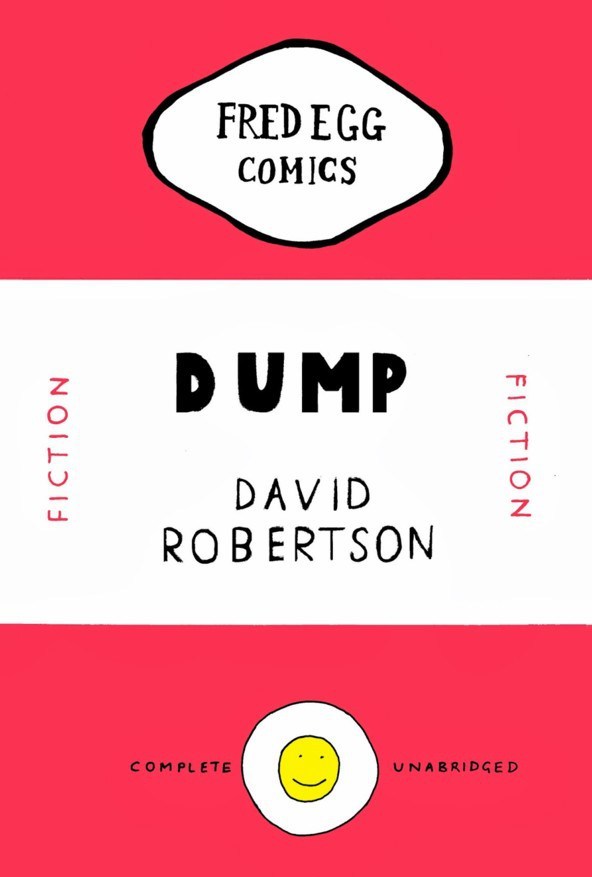
Andy Oliver has written a review of my comic Dump over at Broken Frontier.

Have a read here.

"David Robertson’s Dump #2 – An Anthology Celebration of Grassroots Publishing from Fred Egg Comics

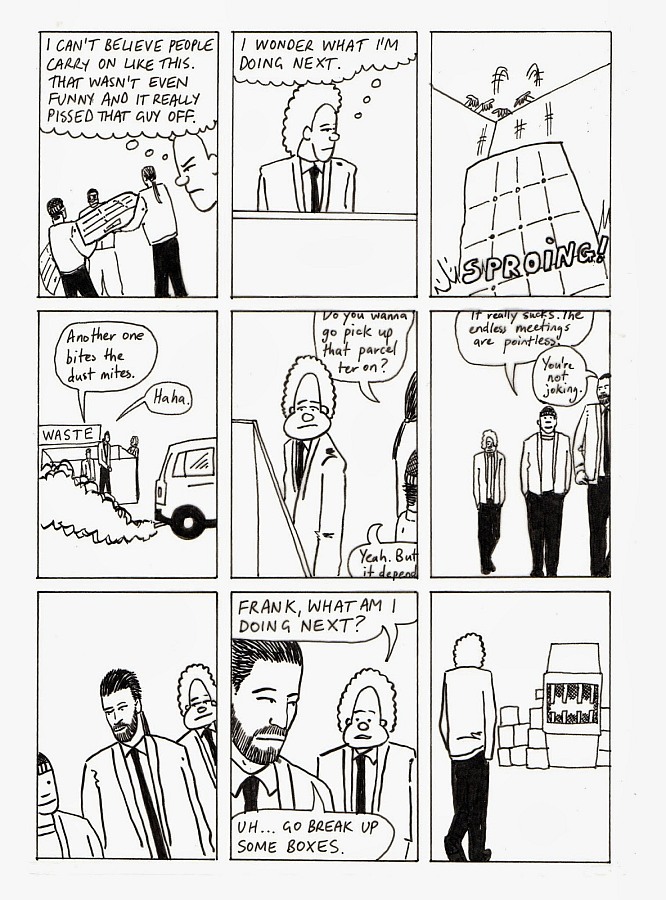
David Robertson’s Dump anthology is one of those refreshingly old school small press publications that embody the DIY culture of self-publishing with an unashamedly eclectic collection of shorts. Published under Robertson’s Fred Egg Comics imprint this second issue diverges from its predecessor in that, apart from Robertson’s own work, it also contains a number of one-page autobio vignette strips that give its guiding light the opportunity to work with a number of other artists; all of whom have their own very distinctive approaches to the comics page.
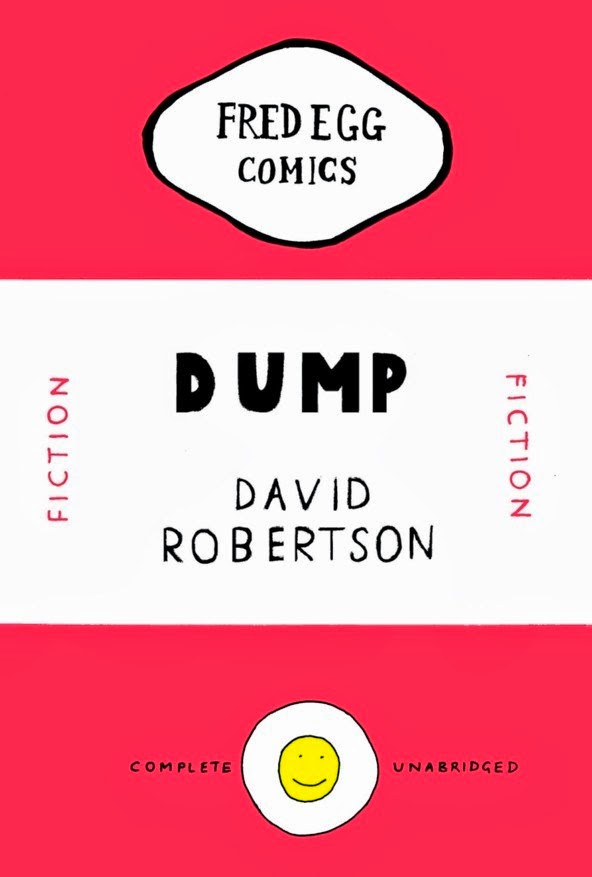
Dumpcoversmall_0814
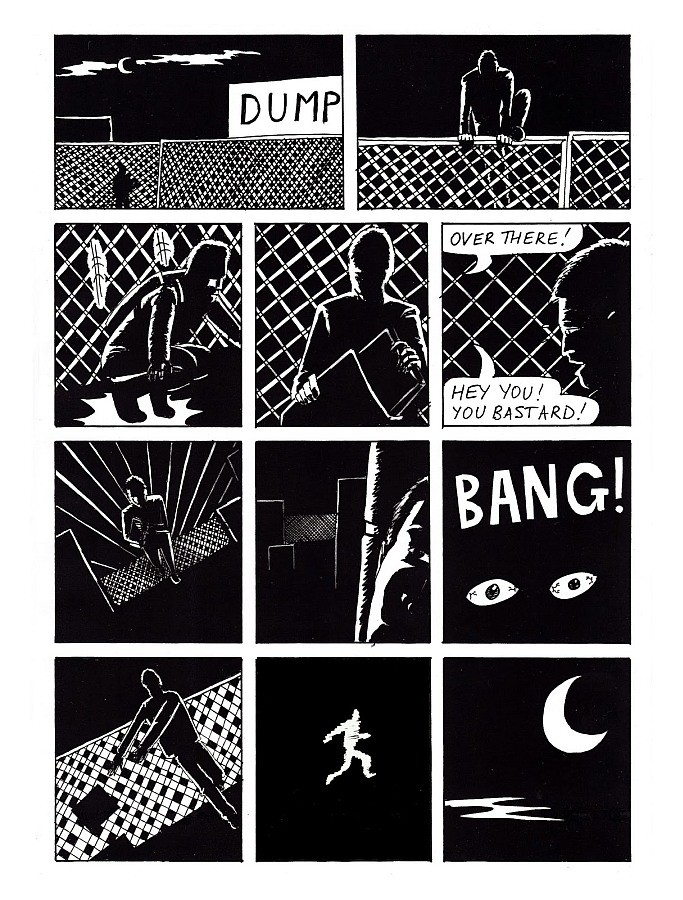
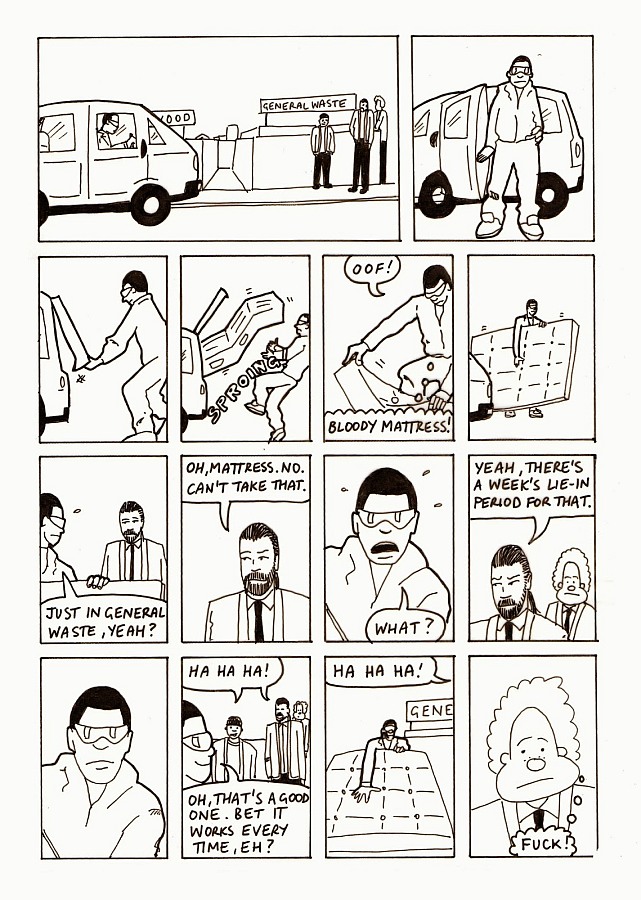
The main story – the titular ‘Dump’ – is a continuation from the previous issue and, perhaps strangely in the circumstances, is probably the least interesting offering here. Its protagonist Bert – a more obviously caricatured character within a world of largely realistically depicted players – is slowly learning the ropes of his new employment in a waste management plant. Amid the humdrum tedium of the pedestrian working day, unexpected intrigue enters the lives of the dump workers when one of them discovers a laptop that just may hold information vital to national security. The main problem I had with ‘Dump’ was that it seems unsure exactly what its premise is. Sometimes it’s apparently a Clerks-style slacker slice-of-lifer and at other points a conspiracy thriller but it never really succeeds in merging the two into a coherent whole.
Of more note are the aforementioned one-pagers where five different artists team up with Robertson. Two strips in particular stand out. The first of these is ‘Dream of Being You’, a collaboration with Stephen Boyd.  In the endnotes to the issue Robertson reveals that Boyd’s art  to this piece already existed and he subsequently added text around it to create a narrative. A simple strip depicting a rain swept street, and a contented dreamer cosily asleep in bed within one of its houses, becomes something far more nuanced here with the writer’s reflective thoughts on the plight of the homeless added to it. Similarly ‘Yay! Party!’ (below) with art by Keara Stewart, focusing on anxiety in social situations, works so well because it’s an instantly recognisable scenario and Stewart’s loose style evocatively captures that sensation of panic we feel when we believe we have lost control of events. The Donna Law illustrated ‘Coleslaw’ – an odd ode to mayonnaise-smothered vegetables – is also fun in its juxtaposition of the timelessness of the inconsequential and the finite nature of human existence.
Dump1_0814The second half of the issue is made up of the four-pager ‘History of E-Mail and the Internet’ (below) and his 24-hour comic ‘Everything’. The former is a thought-provoking encapsulation of the quantum leap in information dissemination over the last two decade; a neat précis of developments in that arena but one that’s quite text heavy and perhaps could have done with being given a little more room to breathe.
Dumpinternet_0814
If there was one strip that really connected with me in Dump #2, though, it’s ‘Everything’. I always find it a little churlish when art on 24-hour comics is criticised because the very nature of the exercise means the work will be raw and unsophisticated. From that statement you can obviously take away a sense that the visuals here are not that polished but for a spontaneous piece of storytelling there are still some inventive touches in these pages. Robertson approached the concept of the 24-hour comic with a pure vision, determined to come to the project without a prepared topical objective.
What we get in these pages is something that is simultaneously extravagantly ambitious and yet utterly down-to-earth. It’s Robertson’s ruminations on the meaning of life boiled down to the pursuit of his own passions – his journey into the world of comics from enthusiast to critic to small press practitioner. Jaunty and engaging in tone if (unsurprisingly) a little rambling in places, it leaves the reader feeling fully invested in Robertson’s love of the form – an almost infectious enthusiasm – despite art that is largely uncomplicated in delivery. There’s also something amusingly self-referential about a small press comic strip about creating small press comic strips…
Dumpsample1_0814 Dumpsample2_0814 Dumpsample3_0814
Sample pages from the lead strip ‘Dump’ 
While Dump is, admittedly, often unrefined in technical presentation it does represent a section of grassroots comics that I am always happy to showcase in ‘Small Pressganged’. As long as the work on offer has something worth saying then that sense of democracy that surrounds self-publishing will be deservedly celebrated here. After all, as Robertson displays with gusto here, the opportunities for getting out there and simply creating your own comics for the sake of it have never been greater."

Sunday, August 10, 2014

TREEHOUSE COMIC 3


I have a 4 page story called "Room Tour" in Treehouse Comic 3.

Cover by Norrie Millar.

The third issue was launched at Tin Roof art studios in Dundee yesterday. STV ran an interview with Stuart McAdam on it here.


"Head to the third Treehouse launch for a very special event

They say good things come in threes and that's exactly what the guys at Treehouse Comics will be hoping for this weekend.

That's because they'll be launching the third instalment of the popular Dundee comic book at a special event at the Tin Roof Art Collective this Saturday from 7pm.
Seven of the finest artists across Scotland have contributed to the comic, which is now available in Waterstones, including popular Dundonian talent David Robertson for the first time.
But, in addition to the exciting next edition of the comic and some free badges, the artsy folk have also built the ultimate treehouse for guests to enjoy.
Designed to resemble the dream treehouse that we all wanted as teenagers, the comic book team have spent most of the past week working to set it all up.
We've been speaking to Stuart McAdam, who edits the comic, for all the inside details and we've even got some teaser images for you to enjoy as well.
In the meantime though, here's the comic's brand new front cover designed by Norrie Miller.

Fans can expect the comic to have the usual eclectic mixture of subject matter, and its tendency to mask more serious ideas or concepts with nonsensical and humourous story-lines.
"The comic is basically a continuation of what we've been doing before with the previous comics," explains Stuart, who along with Neil Scott edits the comic anthology.
"There’s only seven contributors this time round, which is different as we've usually had 12. I've been a wee bit all over the place with various projects so I'm not in this one.
"But we do have a new contributor in David Robertson, who's quite well known in Dundee for his comic - it's called Fred Egg."
What else is different is the fact that the team have spent the last five days constructing a treehouse for guests to enjoy.
Previous events have been much lower-key but Stuart says it's something they've wanted to do for a while.
"To be honest we've wanted to build a treehouse since we first launched the project last year to be honest," he continued.
"Guests will get to enter it and we've built all the walls and the roof. Even the interior will be kitted out like it’s a dream treehouse or club house you wanted when you were 15.
"There will also be a barbeque and a bit of a party for the launch too. We've been doing a few conventions lately so we've got a collection of wee things to sell; for example David Kerr has quite a few mini-books.
"We’ll be going to a convention in Finland this September and to Thought Bubble down in Leeds - which is the biggest comic convention in the UK.
"But on the night, we’ll be giving away badges and we’ll be selling the remaining issues of edition from the first and second comics."


A treehouse installation was built and looked terrific...

Treehouse entrance.
Avril Smart playing games.
Blurred Norrie Millar and Andy Herd.
 Comics were on sale:
Treehouse issues 1-3.
Andy Herd at the Treehouse solo projects table.
Jules Valera's artworks.
There was an exhibition of original art...
Jules Valera preparing.
Exhibition in full swing.
Neil Scott and David Peter Kerr man the table. Damon Herd chatting behind them.
Exhibition still in full swing.
There were artists in who came along and got set to sketching as proceedings went on...
This was the first exhibition I've been in where I was onsite. It was a new experience to have folks studying your work. What's the etiquette? Are you to introduce yourself as the artiste? I decided to leave people to it...
Viewing 'Room Tour' undisturbed.
A great night. I feel lucky to be involved in Treehouse Comics. They have a lot of talent and enthusiasm and are an inspirational bunch. 

The exhibition is on for the rest of the week, so head along to Tin Roof for a look if you can make it!

Tuesday, July 29, 2014

DUMP at HIGH-LOW


Rob Clough has written a review of both issues of my comic Dump over at High-Low.

Have a read here.

"David Robertson is the sort of cartoonist who came around to cartooning with little natural skill but a great deal of desire. His Dump is a gathering ground for short stories he's published in various places, along with several collaborations he's done with other artists. As a writer, he's introspective and fascinated by process and first principles. For example, in his Star Wars pastiche "One Day At Space Wizard Central", he's less interested in the pageantry of their world and more interested in how racism might crop up given that humans die so much quicker than other beings in their order, and how it might be a waste of time to train them. What I like best about it is that there's no particular resolution. "It's Delhi Belly!" is an account of a man who realizes that he has Crohn's Disease and the complications that arise from that. "Sunday" is an hourly comics exercise, where one does a page of autobiographical diary comics once an hour for a whole day. What was interesting about this attempt was how he was able to capture fairly complicated dialogue and get across a sense of what life was like with his wife and two children. "Ps & Qs" cleverly imagines captions for the models at drawing classes. "Berserkotron" and "Dump" continue to follow a character from an older comic as he finds new employment at a factory job that is enormously tedious. There's also a strip about a man being distracted by public bathroom noises as he's deciding whether or not to kill himself and some sillier strips.


Robertson's visual style is bland to the point of distraction, especially in his autobio stories. "Dump" at least has some interesting character design in the face of its protagonist Bert, who has pointy, clown-like hair and a pear-shaped face. "Dump" is by far the most entertaining of the comics in either issue of Dump the series; it's more imaginative and has a livelier look on a panel-to-panel basis. His "History of E-Mail and the Internet" is little more than illustrated text, with words crowding out images in many of the panels. Ironically, the sloppiness of his 24 hour comic "Everything" gives it a bit of visual flavor. The panels are frequently poorly-drawn and wobbly, and the actual drawings are simplistic and functional at best, but that earnestness that Robertson displays in most of his work really comes to the fore here. It's a history of his entire working life, his ambitions, his failures, his dreams and then finally the way he sort of wound up where he was as both artist and critic. Robertson's voice tends to be careful and measured in a way that sometimes spills over into dullness, but there's an enthusiasm in this strip that's palpable without being twee or overstated. Robertson's analytic nature, which is an asset as a journalist and critic, can sometimes stifle the energy of his comics work. What's clear is that this is a long game for him, as he's interested in experimenting, getting better in public and simply getting work out there. Finding a style, a voice and becoming more technically proficient will all come in time as long as he continues to work. "Dump" is still his most promising work, as it matches that flatness of tone with strange goings-on to create a deadpan atmosphere."

Friday, July 25, 2014

COMICS UNMASKED: WORTH A LOOK


I visited the Comics Unmasked exhibition running at The British Library recently.

Please go here to The Comics Grid and see what I wrote about it.

"This exhibition is incredibly well thought out. It was designed to appeal to afficionados and those with more of a passing interest. The wording throughout reflect this, starting with the title. Superheroes must be contended with, and so masks are mentioned. But they are “Unmasked” – cleverly having the superhero cake, and refusing to eat it.
The emphasis is on British comics, and comics with a rebellious, political or somehow “edgy” aspect. Many of the comics still pack a punch, despite decades having gone by. For example, Andy Capp’s vision of domestic abuse with the line “Look at it this way, hon, I’m a man of few pleasures, and one of them ‘appens to be knockin yer about.” “I was a Jap Slave” from a 1950s Adventure Comics annual was very powerful, especially in that context. I read the first two pages and wanted to read more.
There were more widely known names being confirmed as part of the UK comics tradition, including Grayson Perry and Raymond Briggs. There are many comics affiliated items here too: a quite eerie ventriloquist’s dummy of Ally Sloper, loaned by Roger Sabin. I don’t know how he sleeps with that thing in the house. It was good to see Oor Wullie mentioned as “a gentle dreamer and local hero in Dundee, his dialogue in strong Scots”.
Black Holes by Dave McKean was a sudden departure from the mass produced nature of the other comics. Four paintings in a frame with syringes, and writing on the glass, giving a 3D effect. Loaned by the artist, this was definitely an art piece.
V For Vendetta has a notable presence in the exhibit. A wise decision, as it has the recognisability of the mask having reached out to the general public through its appropriation by protest groups such as Occupy. It’s also a very highly regarded book in itself. There was a page of script and corresponding original art page, as well as about 18 masked mannequins. An atmospheric soundtrack played on a loop with chanting, what sounded liked sound effects from the 1970s Invasion of the Body Snatchers movie, police sirens, Alan Moore’s voice with echo on, and more. Too much more. It became distracting to me as I tried to take in the work surrounding it.
There was a table for drawing (I couldn’t resist doodling a Fred Egg Comics logo), a large video screen, showing artists drawing and a wall of process work.
Sex comics are in their own slightly sectioned off area, illuminated by red light. Aubrey Beardsley’s exquisite art had a big influence on Lost Girls, and they were placed together here. I couldn’t help but find Oliver Frey’s Rogue from Him International slightly jarring. I hadn’t seen any of this work before, and primarily associate Frey with Dan Dare. The work leads up to a sort of crisis point around 1973 and the Oz schoolkids issue, with its Rupert the Bear/Robert Crumb mash-up comic (which still makes an impact decades later). After, the exhibition moves to the 1980s and proactive benefit comics such as Strip Aids and Knockabout Comics Anthology 4 – “the obscene issue”. Then it came up to date with work by Hunt Emerson, Sacha Mardou, and others.
The exhibition didn’t ignore superheroes completely of course, as they are a significant part of British comic history. But the ambivalent attitude to superheroes was attested to once again with the quote at the introduction the their dedicated section; Jodorowsky stating “Kill superheroes! Tell your own dreams!” British heroes included Dick Turpin, Dan Dare, Judge Dredd, Slaine, Halo Jones, Tank Girl Zenith, New Statesmen and more. Then it was British creators’ contributions to US comics, under the title “Born in the USA?”;  Pencil and blue pencil art by Frank Quietly for All-Star Superman 1, with interesting notes showing some of the artist’s thinking. Superman’s expression is mirroring his thoughts: “Oh hi, come in”, and his eyebrows are doodled, presumably ahead of the drawing being done.
By an original page and copy of the script was a caption stating “Watchmen is one of the most important graphic novels in any genre.” These words have again been chosen very carefully. I can imagine some people twisting themselves in knots trying to unpack that sentence.
From Arkham Asylum, there was a sheet of paper by Grant Morrison of ideas for each page of the comic, ranging from one to five words for each page. The Joker mask by Dave McKean was also on display.
There was a Sandman script – on loan from Gaiman, which looked brand new. Either it was printed off just prior to handing to the library, or he looks after them extremely well. There was not one bend on those pages. Interestingly, Gaiman had made a mock-up of the whole issue for artist Jill Thompson. It resembled a very rough scribbled minicomic.
She Lives by Woodrow Phoenix is a massive comic with square metre pages of original art. I had a unique experience viewing it. One page has 8×8 panels and I thought “They’re too small” – somewhat like Joe Matt’s Peepshow. But this is a one off art project, not meant for reproduction! These panels will never be shrunk from the size they are – roughly 2.5 to 3 inches – Bigger than your average panel in a comic book page. What an impressive object She Lives is.
Other artworks in this section were Gloaming by Keaton Henson with its related scary house installation, and a digital section with Skint! by Metaphrog, the silent webcomic of John Allan. There was also a backdrop of Gorillaz videos on 2 big screens with no comment.
There are certainly favourite comics I may have hoped to see represented which weren’t, but that’s to be expected. It couldn’t have everything. What I got was a lot of very interesting and stimulating work. I learned a lot seeing this exhibition. I would sum it up by saying it was a very worthwhile, loving and knowledgeable tribute to comics."

Wednesday, July 23, 2014

THOSE PEOPLE ARE NOT GUARDIANS OF THE GALAXY


After having given their biggest characters to Fox and Sony in order to avoid going out of business altogether, Marvel Comics made enough money from their share of the success of Sam Raimi’s Spider-Man and Bryan Singer’s X-Men films to firstly stay alive and then later start up their own movie studio. Against the odds, they somehow had a huge mainstream hit with the character Iron Man, and struck gold with the Avengers movie. Now though, Marvel have pretty much ran out of already popular and famous characters. They are aware of this, and quite cleverly, if cynically, factored it in to the first trailer for the upcoming Guardians of the Galaxy...


“Who are you?” 
“Star Lord” 
“Who?”

Then a roll call of the characters as Peter Serafinowicz is told who they are.

I remember Rocket Raccoon from The Hulk’s 20th anniversary issue, so that’s 1982. He was a bit of a joke character really, with his name a play on the Beatles song. Hulk even complained about him on the cover...


A bit later, there was a lovely looking 4 issue series drawn by Mike Mignola, prior to Hellboy...


Gamora was a terrific character from Jim Starlin’s Warlock series in the mid 70s...


Groot was another one who guest starred in Hulk; in the 1976 Annual drawn by Sal Buscema, to be exact. Groot was originally drawn by Jack Kirby in the old Marvel monster comics. This story had a bunch of old weirdos reappear so the Hulk could smash them to bits one after another. Quite literally in Groot’s case…


Starlord was a good comic by Chris Claremont and John Byrne in the late 70s. Some visceral violent action, shades of Star Wars – “a sith lord” even turns up...


A bit later I bought black and white Star Lord comics aimed at a slighly older audience, with Carmine Infantino drawing a sexy lady called Caryth. Here is her emotional (and topless) death scene...


Star Lord’s costume is completely different in the trailer, I observe.
And wait, why is Star Lord in this film ? Why are any of these people in this movie?
Because I read Guardians of the Galaxy too, and none of these jokers were in there.


The Guardians of the Galaxy were first featured in Marvel Premiere 18 in 1969. I was lucky enough to pick it up in the late 80s for 10p in a second hand bookshop.

It had intriguing concepts . The characters were from different planets in the solar system and so their bodies had grown differently due to their native atmospheric conditions. As well as being a good sci-fi idea, this also gave scope for the characters being distrustful of other “races”.
Then there was poor old (very old) Vance Astro, who had set off on a thousand year space mission in hibernation to the nearest star system, only to find humanity had developed faster than light travel and arrived there hundreds of years before him. They still gave him a hero’s welcome, but he was tortured by the events. And the Badoon were scary villains (I thought the Judoon from Doctor Who owed something to them).


Beautifully drawn by Gene Colan, as you can see above.

I recall the Guardians reappearing to guest in Avengers comics with a few more characters added. 

At some point Marvel must have completely rebooted the Guardians of the Galaxy comic, ditching the original characters, and the movie is based on that.

I feel like I turned up for a Temptations concert and nobody’s left in the band.

Sunday, July 13, 2014

COURTING CONTROVERSY – COMIC CREATORS AND ONLINE ACCESSIBILITY


This is the seventh in a series of guest posts I'm running over the summer. I asked folk to write on any topic at any length - as long as it's comics related. Next up is Gary Smith...

  
I imagine that most comic fans will have an opinion about John Byrne, but the nature of this view will probably be heavily influenced by when readers were first exposed to his work. For fans who were first exposed to his work in the 1970s, he will perhaps be  best remembered as the young hot shot artist who cut his teeth on Iron Fist and helped take the X-Men to new heights of popularity. For fans who began reading in the 80s he may be forever linked with the Fantastic Four or his revamp of the Superman franchise. For fans in the 1990s it will perhaps be his run on She-Hulk or the launch of his Next Men title. Despite this huge catalogue of well received work in the comics industry, it's likely that fans introduced to John Byrne after the year 2000 will associate him less with his creative output and more with the forthright views he expresses through his website and forum, regularly giving his honest opinion on characters, creators and developments within the world of comics. From the controversy that surrounded his comments on Jessica Alba's casting as Sue Storm to the coining of the term Byrne-stealing (essentially arguing that reading a book and putting it back on the stands without purchasing it amounted to theft), in recent years there have been no shortage of newsworthy quotes arising from Byrne's use of social media.


My thoughts drifted to John Byrne after reading the recent Marvel title, All New X-Factor issue 7. In it, two characters have a discussion about whether a creator should be separated from their work, and whether it is justifiable to read a book - and therefore implicitly support - an author that may have questionable views. The character of Quicksilver is outraged that his team-mate, Danger, is reading a novel by Scott Dakei, a prominent anti mutant campaigner. Danger, for her part, argues that the content of the novel have nothing to do with this issue, and that the author's personal politics do not factor into the novel at all. This debate struck a chord with me because while John Byrne is perhaps the most prominent example, comic fans now enjoy a level of unprecedented access to creators, engaging with them in a way that would have been unthinkable even ten years ago.

1960s Marvel was built on the illusion that it was one big, happy community. Creators were given nicknames, letters pages were answered in a more informal manner; even caption boxes and editors' notes were written in a jocular style. Yet for all this informality, fans at the time were unlikely to know where the creators stood on popular issues (aside from generic representations of the national mood, such as the fear of communism). As the new wave of Marvel writers emerged in the 1970s, including Steve Gerber and Steve Englehart, it was apparent that many of them were politically to the left of their older colleagues, but unless a reader ventured into the world of the fan press it is unlikely that they would have been able to definitively pinpoint their views. 

In the modern comic community, with the majority of creators having a presence on Facebook and Twitter, as well as their own Blogs or web sites, it's relatively easy for fans to work out just where their favourite creators stand on certain issues. Countless creators are only too keen to tweet their thoughts on every conceivable subject, from the serious to the mundane. The question is whether any thoughts so expressed should have an impact on the way that their work is perceived.

In a perfect world the answer would be no. As long as the offensive opinions aren't reflected in their work then there should be no reason not to buy it, and readers should be able to enjoy the work on its own merits. In practice, though, this can sometimes be harder to do. Personally, I have been somewhat surprised by the number of people I have recently seen on Facebook vowing to remove from their friend list anyone that they know to have voted for UKIP in the recent elections. To many people, casting a vote in this way, despite being people exercising their democratic right to vote for a party of their choosing, appears to be so horrific that it outweighs every favourable quality those individuals may possess.


Alongside John Byrne, Dave Sim is another creator who became as famous for his outspoken views as he was for his creative output - perhaps even more so. His essays in each issue of Cerebus highlighted his views on a variety of subjects, with many relating to his views on woman. Courting much controversy, Cerebus, and much of Sim's work, is viewed by many as a platform for him to express his worldview. That raises an interesting point. Sim is undoubtedly a talented creator, yet many readers left Cerebus before the end of its run, growing weary of the increasingly specific direction that Sim's views were taking the title down. Let's imagine that Sim stuns the comic world by agreeing to work on a mainstream superhero - say, Green Arrow. Should it matter that he has strong opinions that may be objectionable to some? If someone admires him as a creator but despises his politics, is there any reason for them to boycott a run that is unlikely to feature as distinct an authorial voice?

There are no easy answers to this topic and I can fully understand why some readers may be so put off by a creator's behaviour that they may boycott their work, but what advantage is gained in doing so? If the creator hasn't advocated anything illegal or morally dubious, is this still enough to transform the way their work is perceived?

For me, much of it comes down to admiration. I want the creators that I admire to also be people that I can admire, ones that share my views and act in a way that I think is appropriate. Sadly, this isn't always the case, but as I grow older I'm increasingly accepting of the fact that life is made up of all sorts of people, with a huge variety of views. If a creator produces fantastic work then perhaps that is enough. If they're also what I would consider a 'decent' person, then that's even better. Or if I really want to preserve my enjoyment of my favourite creators perhaps I should refrain from social media and recapture some of that mystique that creators had to earlier generations of fans. Sometimes, it must be said, ignorance really is bliss.